Can we remove the human from review?
In my most recent blog post (opens in a new tab), I talked about review being the bottleneck in software development cycles. In this one, I will try to answer whether we can remove the human from the review process and resolve the issue of review blocking more features from getting shipped. In my opinion, this is possible, but only if we make sure that the pipeline we have built for delivering the software includes all of the necessary tools that would prevent things from going wrong. The removal of people from the review process will be a very long and troublesome path, but I think that this path is the one we should take to ensure that we can keep up with the tempo of AI-driven development.
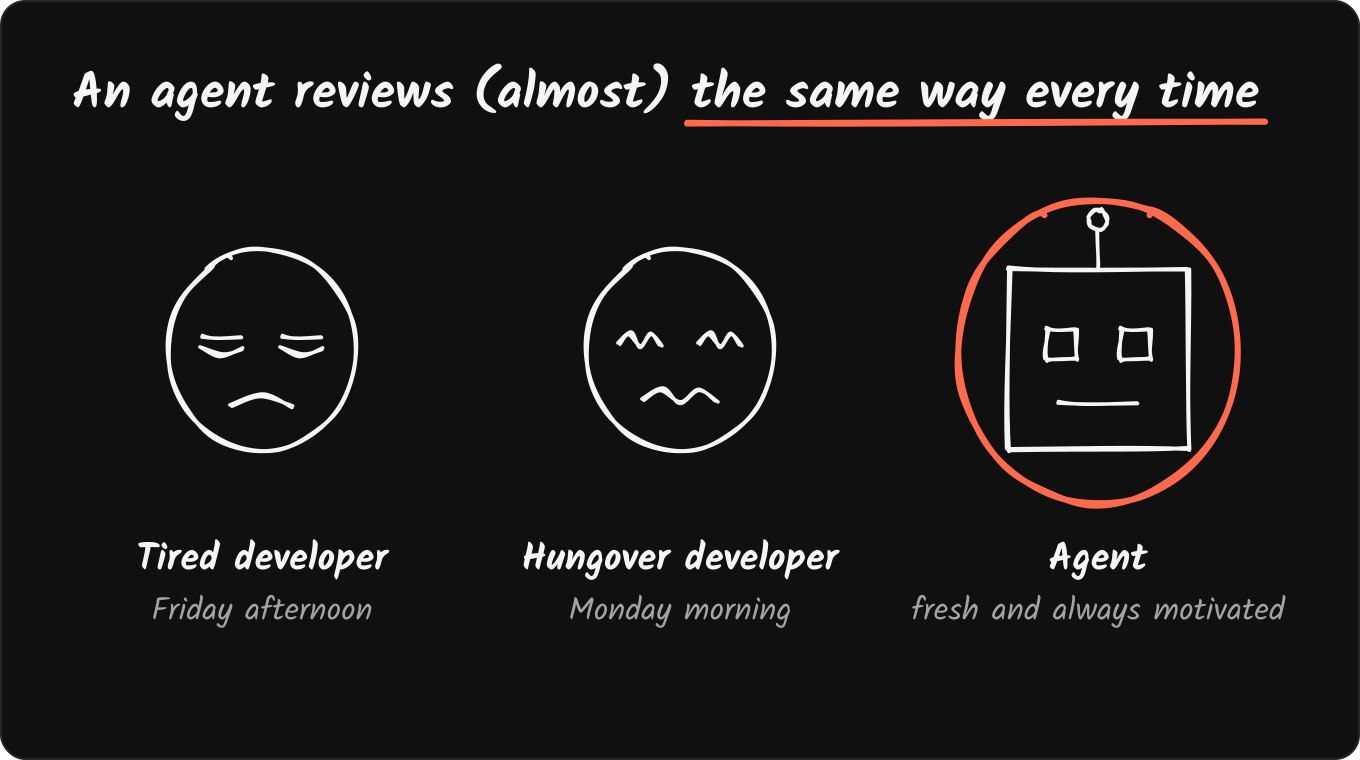
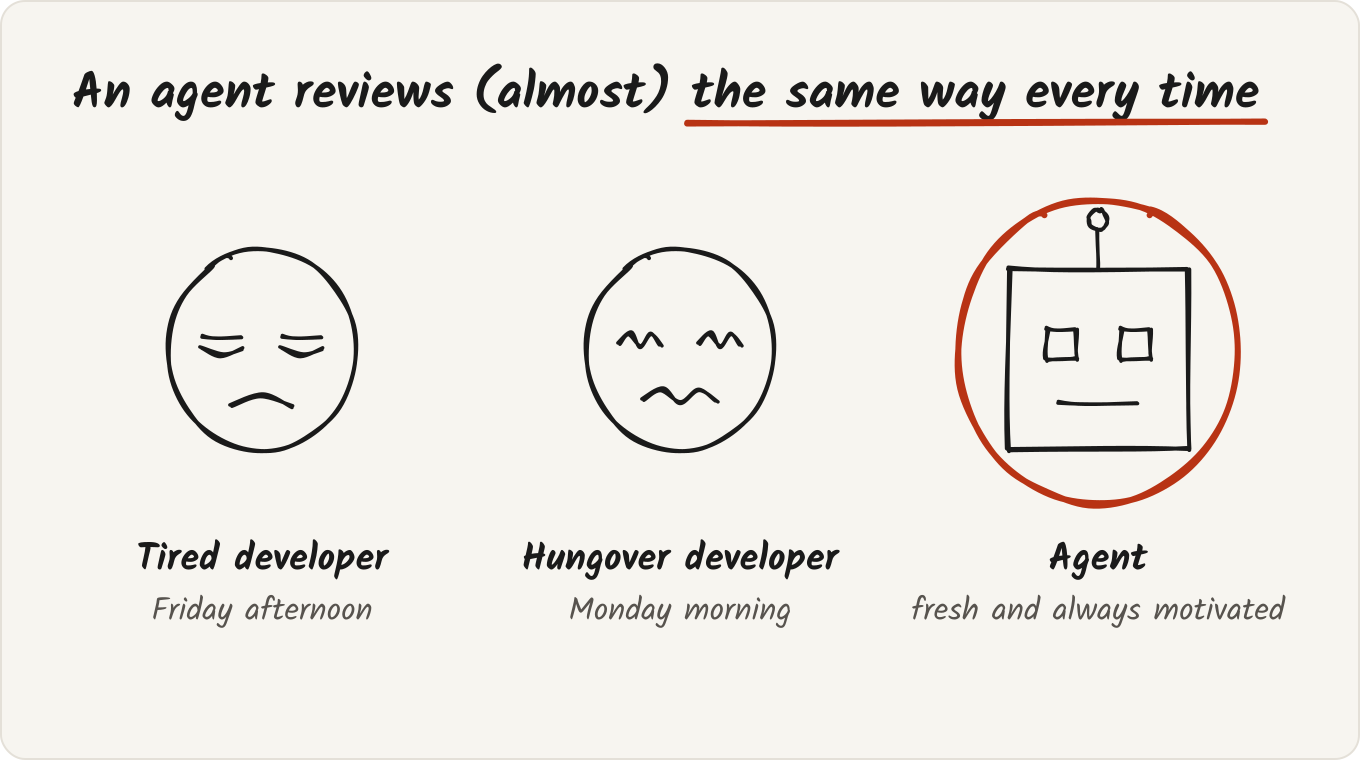
When talking about the removal of the human reviewer from the review process, there is always a mention of who will be responsible when things go wrong. Are the reviewers even responsible today? To some extent, yes, but the ownership of the work done still lies with the developer (not AI) who wrote this functionality. Who would you rather have reviewing your code: a tired developer on a Friday afternoon, a hungover developer on a Monday morning, or a fresh and always motivated agent that behaves (almost) identically every single time, no matter when or what situation we are in? With the layoffs across the industry and shifting to AI-first processes, there is less manual QA work being done, so here too we need to lean on AI to do this job. AI can often think of more edge cases, and we should make sure that it does by setting the rules or skills for agents to check for as many scenarios as possible that can happen in the real world.
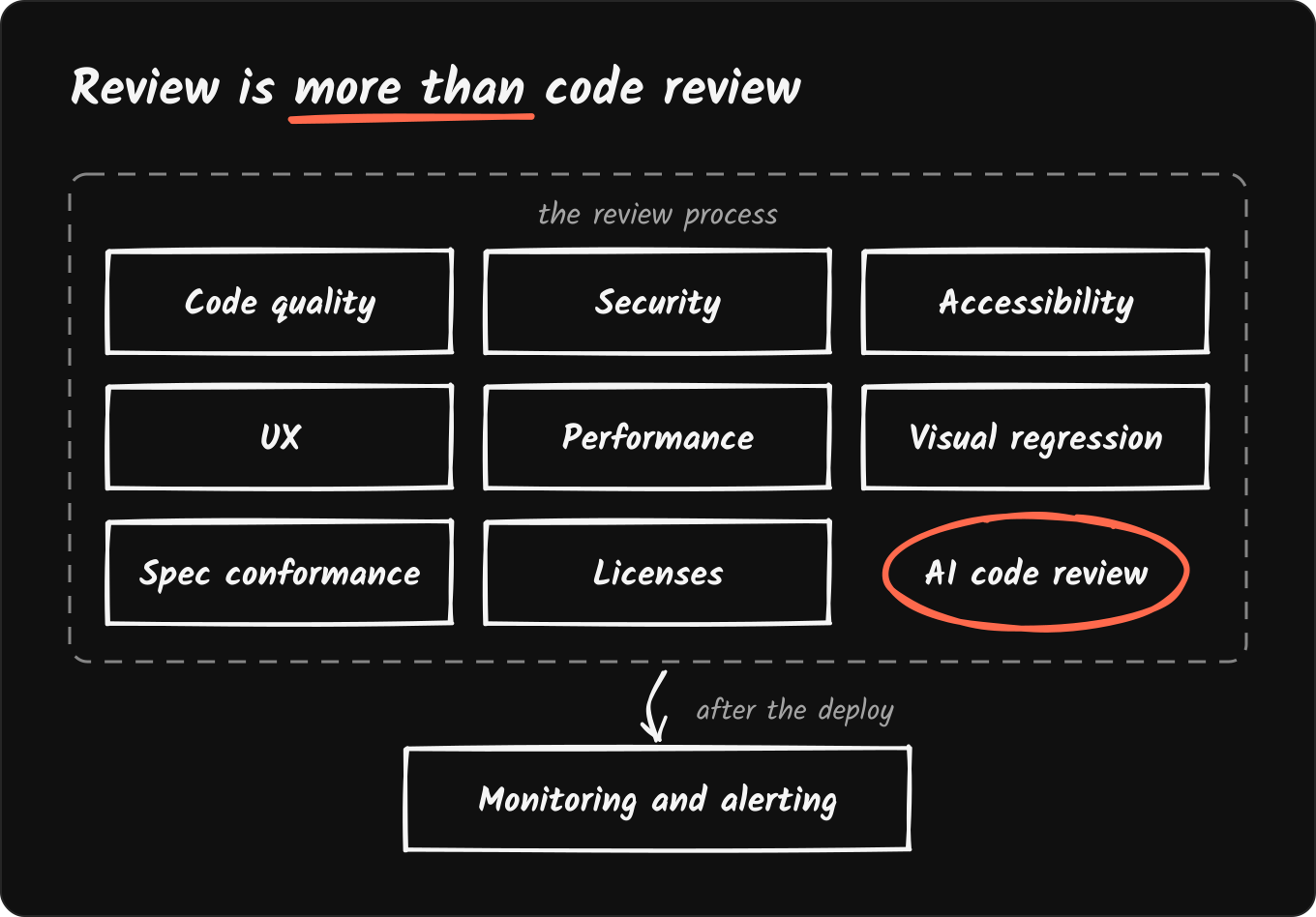
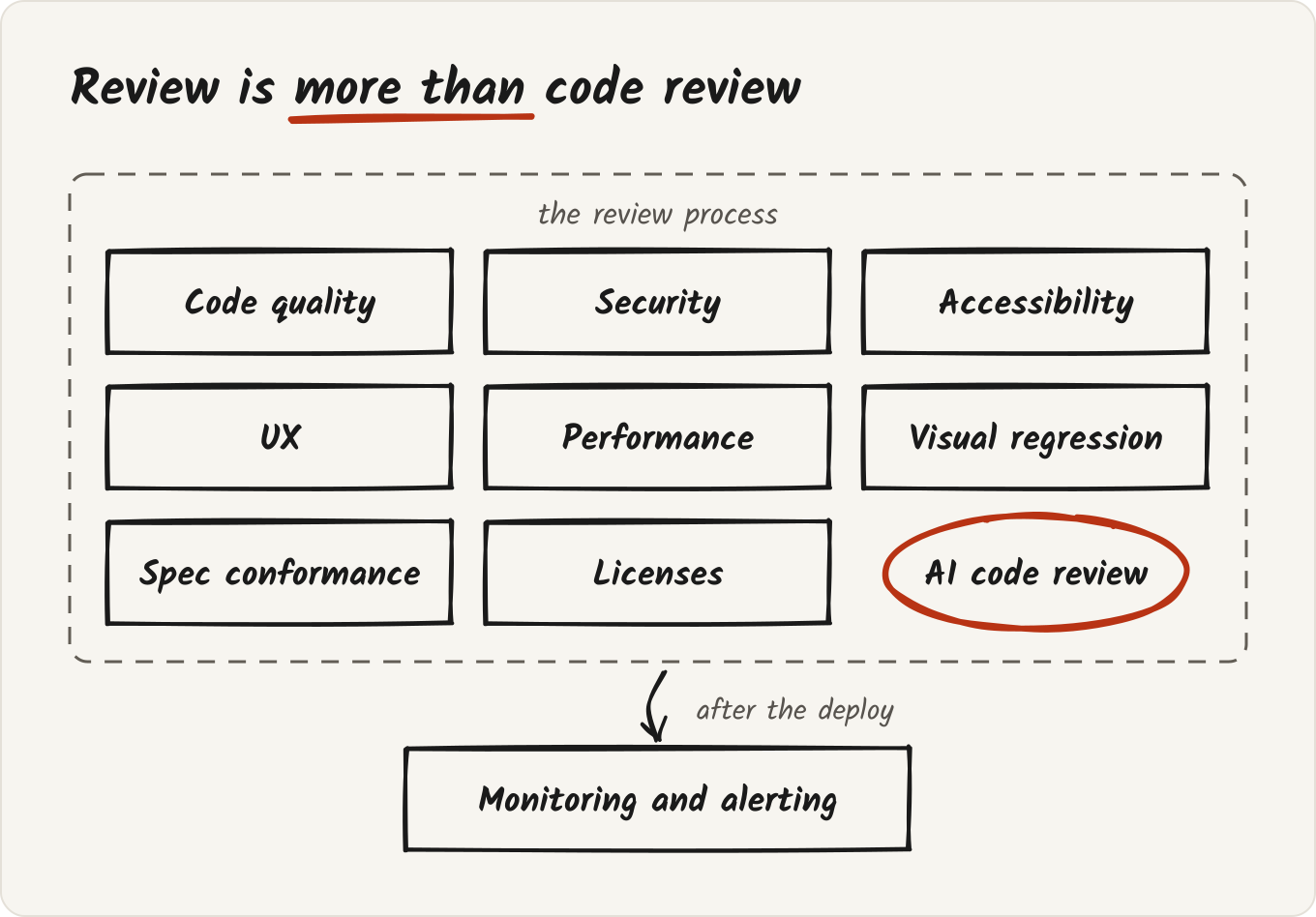
When we are talking about the review process, there is not only code review to talk about. The review process should include as many deterministic tools as possible to make sure that we do not introduce any part of the code that will make our whole codebase worse. There are tools to check for clean code and good practices for code quality. Security review makes sure we are not leaking any secrets or data, using any weak algorithms, or including libraries that have vulnerabilities that expose our software to attackers. We also need to make sure that our software checks all the boxes in the accessibility and UX reviews. Performance checks make sure we are not making the bundle bigger or the load times and Core Web Vitals worse. Visual regression tests make sure the UI did not change where we did not want it to. Spec conformance checks that the code does what the specification asked for. License checks make sure we are not including libraries we are not allowed to use. After the deploy, monitoring and alerting tell us when something goes wrong, because a rollback only helps if someone notices the problem.
LLMs are non-deterministic, so an AI reviewer can have different findings if you run it over the same code multiple times. Rules and guidelines make it behave almost identically. The development team needs to make sure that they write rules for the AI review in the most deterministic way to have the best possible outcome from the AI reviewer.
There are a lot of mentions of completely autonomous software factories that do not require any human effort at all. I have not been part of any of the teams that made it to that point, mostly because in larger and more complex systems, where you have to maintain huge codebases of large products, there is a much higher risk of something not going to plan. But this should not be an excuse not to move in that direction. There should be a lot of effort put in to also adapt those big and complex systems to agentic and AI workflows.
In my work, we are automating a lot of steps in our software development cycles, and there is less human interaction every single day. At the start, there were just testing and linters to make sure that the code was clean. Then there were tools that handle secret detection and vulnerability checks. Code quality gates prevent us from making the code worse. Automatic deployment as soon as the code is merged is absolutely a must-have requirement nowadays, with a rollback option in case anything goes wrong. A merge deploys to staging, and a release deploys to production. Last but not least, we are also addressing the elephant in the room by introducing an AI agent reviewer that checks the code and makes comments on the merge requests. We talk about it in this whole article, and it is also the main protagonist of the title. After the pipeline passes, we usually assign the AI code reviewer to review the code and then also send it for human review.
In those automatic workflows, such as software factories, the most important part is the starting point. The specification or list of requirements is the main thing that a human provides, and here too, I think we need to use AI to help us with that. A good practice is the wayfinder skill (opens in a new tab) from AI guru Matt Pocock (opens in a new tab). It runs through a series of questions to ensure that every open question has been thought about. You can think of it as an extensive brainstorming session with an LLM agent. I have been including Matt's skills in my everyday work for a few months now, and I have to say it has made the transition to using AI or agentic workflows a lot easier.
All of those steps need to be introduced gradually. A complete refactor of the pipeline is maybe not a good idea because it is harder to detect a defect if multiple changes are made. Each step needs to be improved, tested, and validated to make sure that we have done things right. Before moving on to the next step, multiple MRs have to be successful (either passing or failing, depending on the desired outcome). We can start with 5 and then increase it if we see it is not enough. A step is stable when there have been no defects and no flaky or broken jobs in the pipeline. If something is caught, the pipeline needs to fail. A successful pipeline with examples of bad code is a failure. There should also be an order of priorities in which those steps are improved and automated. Automatic deployment is a must and the number one priority. So is a rollback in case of any issues or failures. Linters and tests are covered in most projects, as they were automated first, and deployment came later. But nowadays, deployment is the first thing to fix or automate. Then come code quality control and testing. Then the security review, then the UX review. Removing the human from the review is just the last step. We are moving in that direction.
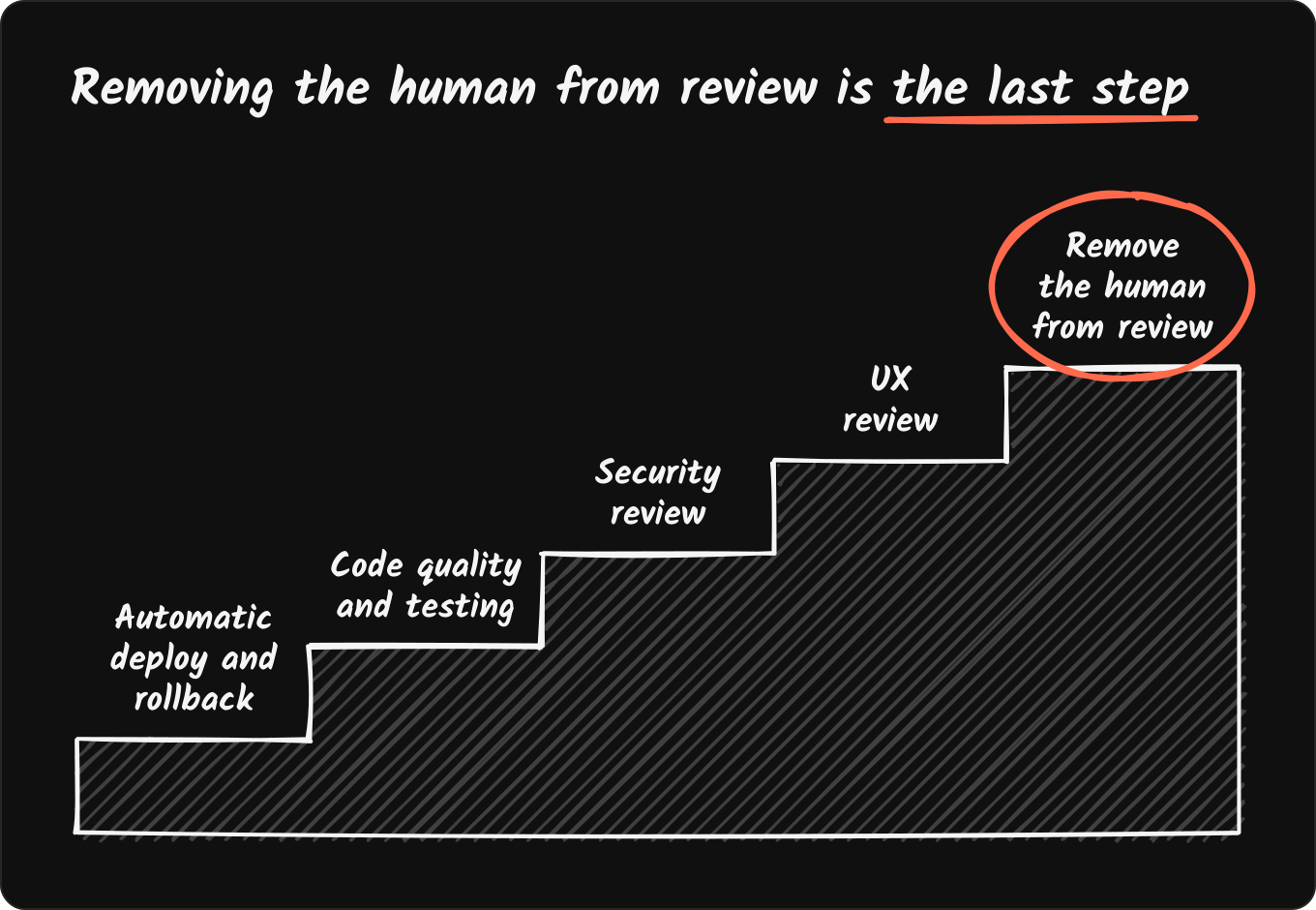
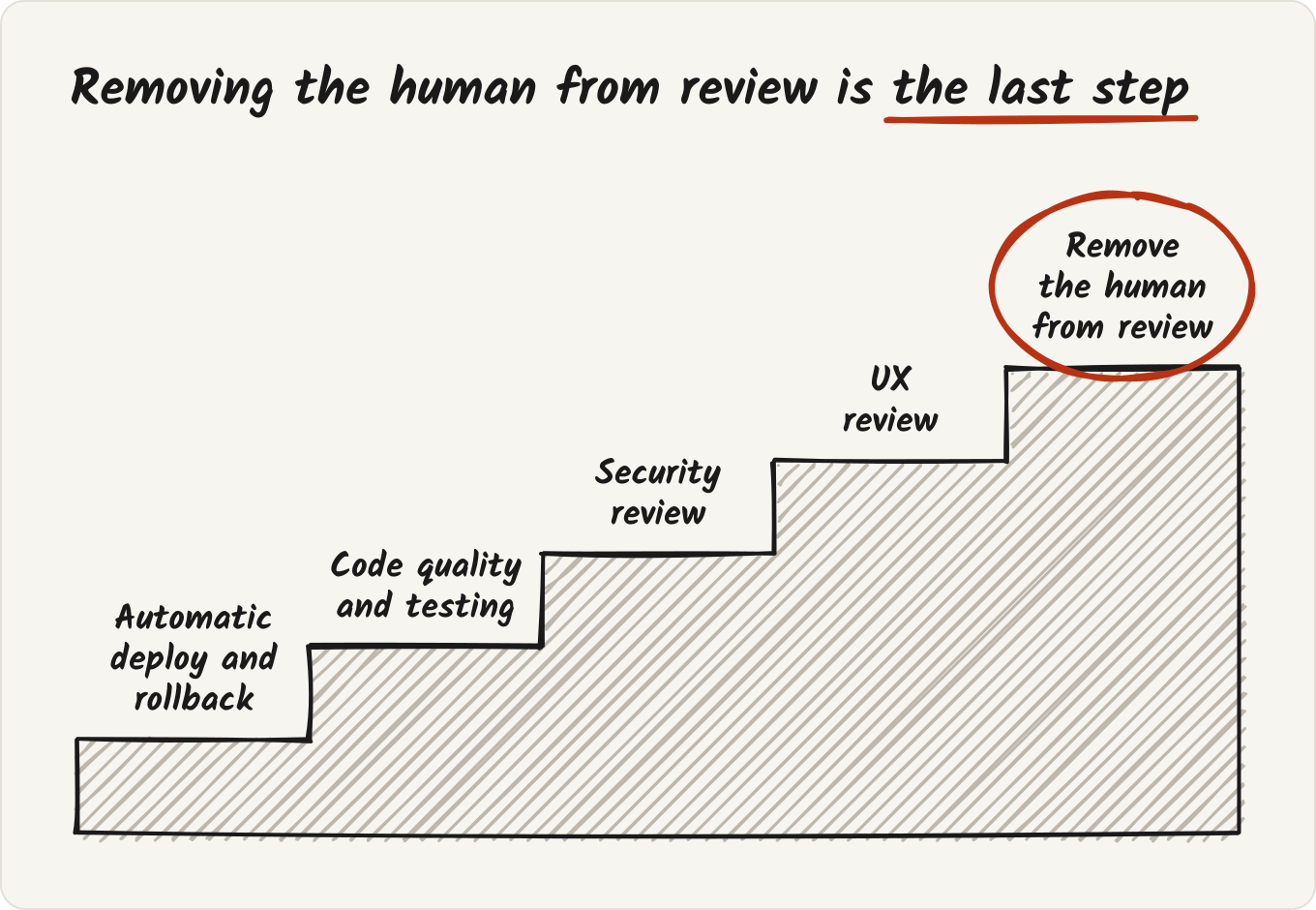
It will be a long and troublesome path, but the human can be removed from the review, and in the future this will be a must.